A dart corner in a small space: compact yet complete
No attic or man cave needed: a proper dart corner fits in a hallway, on a landing or in a corner of the living room. These are the measurements you really need, plus smart choices for tight spaces.
The minimum measurements
- Depth: 2.37 metres throwing distance plus around 70 cm to stand, so count on a good 3 metres of clear line
- Width: one metre is enough, the throwing lane is narrow
- Height: the bullseye hangs at 1.73 metres, so every normal room qualifies
- Above a door or in a hallway works fine, as long as nobody walks through the throwing lane
Smart choices with little space
- Skip the long mat and mark the oche with a strip of tape or a narrow floor strip
- Choose a surround ring instead of a wide backboard: the same protection, much less visual mass
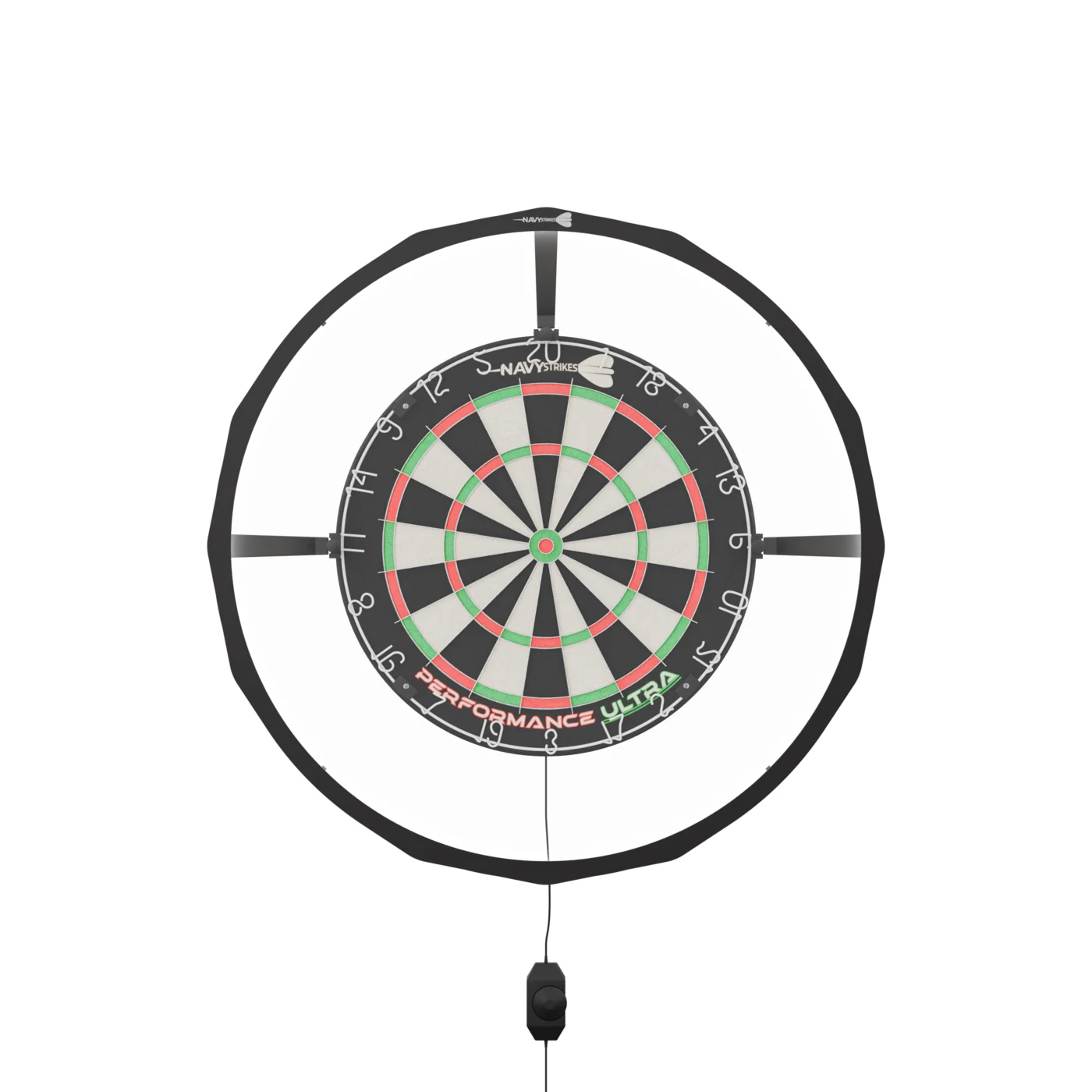
- 360 degree lighting turns a dark little corner into the eye-catcher of the room
- Keep the setup tidy-away-able: darts and scoreboard in a drawer, and the corner is just a room again
The walking route is the real limitation
Not the wall but the throwing lane determines whether a spot is suitable. Avoid places where doors swing into the lane or where housemates walk through: a dart in flight is not a toy. A quiet corner of 3 by 1 metres is therefore more valuable than a large room full of through-traffic.
Frequently asked questions
How much space do I need at a minimum for a dartboard?
A good 3 metres deep (throwing distance plus standing spot) and about one metre wide. Measure it out with tape before you hang it.
Can a dartboard go in the living room?
Certainly, and with a surround and neat lighting it becomes an eye-catcher rather than an obstacle. Choose a wall without through-traffic and you are set.
What if I just fall short of the 2.37 metres?
Then choose one fixed, slightly shorter distance for home. Fixed matters more than official: you still build a consistent throw, though you will need to adjust elsewhere.